



Lisa Adams

Lisa Adams
A sustainable diet for weight loss is an eating pattern that helps you lose fat without the rebound cycle of yo‑yo dieting, extreme restriction, and burnout. Evidence‑based nutrition guidance, including advice consistent with the NHS and WHO, supports a moderate calorie deficit, strong satiety, enough protein, and behaviour change that lasts, which is why the Mediterranean diet and DASH diet are often used as practical models.
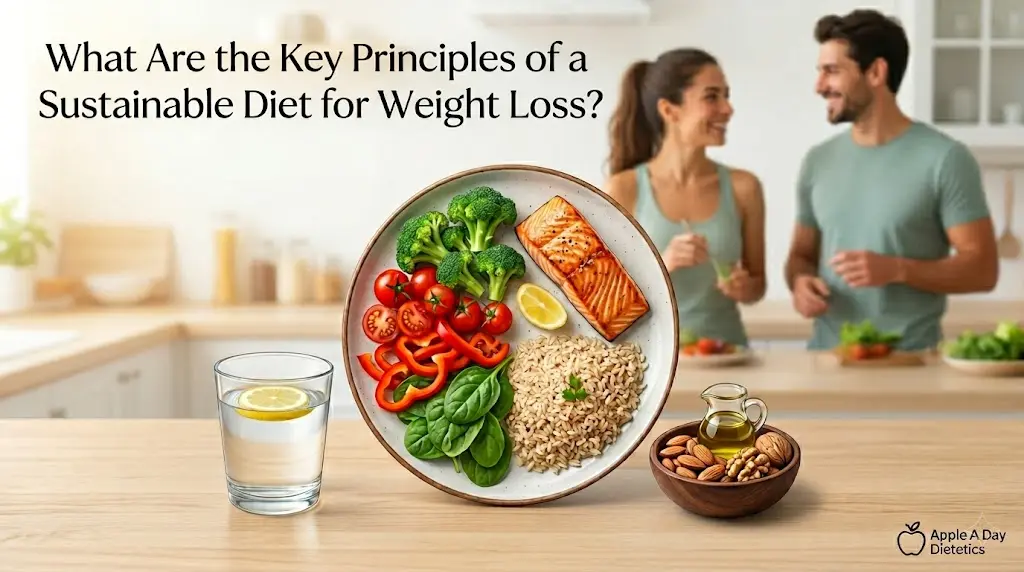
The key principles of a sustainable diet for weight loss are the core habits that make this pattern work in real life. These principles together form an approach that replaces quick fixes with a realistic, repeatable way of eating you can follow long term.
Implicitly, the key principles of a sustainable diet for weight loss are:
A moderate calorie deficit that fits your energy needs and lifestyle instead of aggressive cutting.
An emphasis on protein and satiety so meals feel full and cravings are easier to manage.
Meals built around whole foods and high‑volume, low‑energy‑density options to naturally reduce calories.
Food flexibility and no strict bans, so you can enjoy treats and social eating without guilt.
Attention to hunger and fullness signals and simple meal timing so eating feels structured but not rigid.
Reliance on behaviour change and habit formation (like simple routines) instead of willpower alone.
A plan that fits your real life, including work, family, and social events, so long‑term adherence is high.
What Are the 7 Key Principles of a Sustainable Diet for Weight Loss?
A sustainable weight-loss diet is built on habits you can maintain long-term — not short-lived restrictions. It balances a safe caloric deficit with nutrient-dense, whole-food choices that support metabolism, muscle, and mental health alike. A sustainable diet for weight loss is built on seven evidence-based principles that prioritise long-term adherence over short-term restriction.
1. Maintain a Manageable Caloric Deficit
Weight loss occurs when your body expends more energy than it takes in. However, the size of that deficit matters enormously for long-term success. Aggressive cuts of 1,000+ calories per day trigger hormonal adaptations — reduced leptin, elevated ghrelin, that dramatically increase hunger and slow your resting metabolic rate. Fothergill et al., 2016
The evidence-based sweet spot: A modest deficit of 300–500 calories per day produces 0.25–0.5 kg of fat loss per week, steady enough to preserve muscle and slow enough that your body doesn’t mount a strong metabolic defence.
Use your Total Daily Energy Expenditure (TDEE) as a baseline, calculated from your age, weight, height, and activity level, then subtract 300–500 calories. Reassess every 4–6 weeks as your body composition changes. WHO, 2003 Apple a Day Dietetics, 2025
Crash diets don’t just fail; they often leave people metabolically worse off. Research tracking “Biggest Loser” contestants found their resting metabolisms had slowed by roughly 500 calories per day six years after the show — a persistent adaptation to aggressive restriction. Fothergill et al., 2016.
2. Prioritise Lean Protein at Every Meal
Protein is the single most important macronutrient for sustainable weight loss. It has the highest thermic effect of food (TEF) — your body burns roughly 20–30% of protein calories just digesting it — and it is far more satiating per calorie than carbohydrates or fat. Westerterp-Plantenga et al., 2009
Target intake: 1.6–2.2 g of protein per kilogram of bodyweight per day during a caloric deficit helps preserve lean muscle mass, keeping your metabolism elevated as you lose weight.
The best lean sources to build meals around include poultry (chicken, turkey), fatty fish (salmon, mackerel), eggs, Greek yogurt, cottage cheese, tofu, tempeh, edamame, and legumes (lentils, chickpeas, black beans). NCBI, Dietary Protein & Obesity.
High-protein eating also directly reduces cravings and late-night snacking by stabilising blood glucose and suppressing the hunger hormone ghrelin. A landmark meta-analysis found that higher-protein diets produced significantly greater weight loss and fat mass reductions compared to standard-protein diets. Leidy et al., 2015
3. Fill Half Your Plate With Whole, Plant-Based Foods
Whole vegetables, fruits, legumes, and unprocessed grains are low in caloric density and high in water content, dietary fibre, vitamins, and phytonutrients. Eating them in abundance allows you to achieve physical fullness on fewer total calories — a concept called “volume eating.” Rolls, 2009
Fibre’s dual role: Dietary fibre slows gastric emptying and blunts the glycaemic response, keeping blood sugar stable. It also feeds beneficial gut bacteria that produce short-chain fatty acids linked to improved metabolic health and reduced visceral fat.
The Harvard T.H. Chan School of Public Health’s Healthy Eating Plate recommends that vegetables and fruits make up half of every meal, with an emphasis on variety and colour. Harvard T.H. Chan, 2023
A systematic review published in Nutrients found that plant-based dietary patterns — even partial ones — were associated with significantly lower BMI, waist circumference, and body fat percentage compared to omnivore diets. Dinu et al., 2017 — PMC5726407
4. Choose Complex Carbohydrates Over Refined Grains
Refined carbohydrates — white bread, white rice, pastries, sugary drinks — are rapidly digested and cause sharp rises and subsequent crashes in blood glucose. These glucose crashes trigger hunger and cravings within hours, driving overconsumption. Ludwig et al., 2021
Swap these: White rice → brown rice or barley. White bread → 100% wholegrain sourdough. Pasta → whole-wheat pasta or legume-based pasta. Breakfast cereal → rolled oats. These swaps reduce glycaemic load without sacrificing satisfaction.
Complex carbohydrates from whole grains, legumes, and root vegetables are digested slowly, providing sustained energy over 3–4 hours, preventing the hunger rebound that sabotages most diets. Mayo Clinic, Healthy Weight Loss
A 2021 randomised controlled trial from Boston Children’s Hospital found that a low-glycaemic-load diet — centred on complex carbohydrates — led to significantly greater calorie burning at rest compared to a low-fat diet, suggesting favourable metabolic effects independent of weight loss alone. Ludwig et al., 2021 — BMJ
5. Swap Saturated Fats for Healthy Unsaturated Fats
Dietary fat is essential — it aids the absorption of fat-soluble vitamins (A, D, E, K), supports hormone production, and is critical for brain health. The key is type, not total elimination. Saturated and trans fats found in processed snacks, heavy red meats, and fried foods drive inflammation and cardiovascular risk without meaningful satiety benefits. WHO Europe, Healthy Lifestyle Nutrition.
Prioritise these fat sources: Extra-virgin olive oil, avocado, walnuts, almonds, chia seeds, flaxseed, and oily fish (salmon, sardines, and mackerel). These contain monounsaturated and omega-3 polyunsaturated fatty acids that actively support appetite regulation and metabolic health.
Omega-3 fatty acids in particular have been shown to reduce triglycerides, lower inflammatory markers, and may improve insulin sensitivity — all of which support a favourable metabolic environment for fat loss. PMC5726407, Dinu et al.
The Mediterranean dietary pattern — which derives a substantial portion of calories from olive oil and fish — consistently outperforms low-fat diets for weight loss maintenance in long-term studies. Estruch et al., PREDIMED Trial, NEJM
6. Practice Mindful Hydration
The brain regions regulating thirst and hunger are closely linked, meaning mild dehydration is frequently misinterpreted as a food craving. Adequate hydration is one of the most underrated — and lowest-effort — levers for reducing unintentional calorie intake. Popkin et al., 2010
Evidence-based hydration habits: Drink 2–3 litres of water per day (adjusting for body size, climate, and exercise). Drink a 500 ml glass of water 20–30 minutes before each meal clinical trials show this reduces meal calorie intake by roughly 13% in middle-aged and older adults.
A randomised controlled trial published in Obesity found that adults who drank 500 ml of water before each main meal lost 44% more weight over 12 weeks than those who didn’t pre-load with water. Dennis et al., 2010 — Obesity
Green tea and black coffee (without added sugar) can also support fat oxidation and thermogenesis at a modest level, making them useful low-calorie alternatives to sugary drinks. Avoid liquid calories from sodas, juices, and alcohol, which contribute significantly to calorie surplus without triggering equivalent satiety signals. Apollo 247 Dietetics, 2024.
7. Build in Flexibility and Avoid All-or-Nothing Thinking
This is the principle that separates diets that last months from eating habits that last decades. Any dietary strategy that completely eliminates favourite foods creates psychological deprivation and deprivation is the leading driver of binge eating and diet abandonment. SBM, 7 Components of a Successful Weight Loss Plan.
The 80/20 framework: Aim for nutrient-dense, whole-food eating roughly 80% of the time. The remaining 20% allows for social meals, treats, and flexibility without guilt, without spiralling. This removes the “I’ve ruined it” mindset that causes people to abandon healthy habits entirely after a single indulgent meal.
Behavioural science research consistently shows that dietary restraint rigidity — not flexible restraint — is associated with higher BMI, greater emotional eating, and poorer long-term outcomes. The most successful long-term weight managers practise what researchers call “cognitive flexibility”: they enjoy occasional indulgences consciously and return to their baseline without self-punishment. Smith et al., IJBNPA
Plan your flexibility intentionally: schedule a weekly social meal, allow a small daily treat, and never classify foods as “forbidden.” Sustainable weight loss is a lifestyle architecture project, not a willpower contest. WHO, Diet, Nutrition and the Prevention of Chronic Diseases
The best sustainable diet for weight loss is the one you can follow consistently in a calorie deficit, and no single diet is best for everyone because adherence is the main variable. Registered dietitian guidance and major health bodies consistently favour patterns that are balanced, flexible, and realistic, which is why the Mediterranean diet, DASH diet, and high-protein flexible dieting all remain strong options.
What Is the Most Sustainable Diet for Weight Loss?
The best sustainable diet for weight loss is the one you can follow consistently in a calorie deficit, and no single diet is best for everyone because adherence is the main variable. Registered dietitian guidance and major health bodies consistently favour patterns that are balanced, flexible, and realistic, which is why the Mediterranean diet, DASH diet, and high-protein flexible dieting all remain strong options.
| Diet | Key Features | Best For | Evidence Level |
|---|---|---|---|
| Mediterranean diet | Plant-forward, olive oil, fish, whole grains, legumes, fewer processed foods | People who want a flexible, heart-healthy pattern | Strong |
| DASH diet | Fruits, vegetables, whole grains, low-fat dairy, less sodium, lean protein | People who want structure and blood-pressure benefits | Strong |
| High-protein flexible dieting | Protein-focused, calorie-aware, no foods are off-limits, behaviour-friendly | People who want satiety and easier adherence | Moderate to strong |
Gender-specific sections
For men, the most sustainable plan usually is the one that makes protein, fibre, and portion control easy enough to repeat on busy workdays. For women, the most sustainable plan usually is the one that supports satiety, hormonal comfort, and long-term adherence without feeling overly restrictive.
What Diet Is Best for Weight Loss Females?
The most effective diet plan for weight loss for women is one that supports female metabolism, hormone balance, and long‑term adherence, rather than extreme restriction. Evidence‑based options such as the Mediterranean Diet/DASH diets, High‑Protein, Lower‑Carb plans, and structured programs like the CSIRO Total Wellbeing Diet all align well with women’s unique hormonal and metabolic needs.
Hormonal context
Oestrogen and progesterone shift across the menstrual cycle, which can influence appetite, cravings, and energy, so many women find their hunger varies between cycle phases. A hormonal weight loss‑friendly plan accounts for these fluctuations instead of imposing a rigid “one‑size‑fits‑all” pattern every day.
Best‑fit approaches
Anti‑inflammatory, Mediterranean‑style eating patterns work especially well for women because they help reduce systemic inflammation and support oestrogen and fat loss balance. Cycle‑synced nutrition can further refine this by slightly adjusting protein, carbohydrate, and fat based on phase, but only once the basics of adequate calories and good‑quality food are in place.
Pitfalls unique to women
Women are more likely than men to under‑fuelling when aiming for weight loss, which can disrupt cycles, increase fatigue, and slow metabolism. Conditions such as PCOS and perimenopause also change how the body stores fat and responds to insulin, so a targeted PCOS diet or hormone‑informed approach is often necessary rather than a generic “eat less, move more” message.
When to seek personalised support
Because female metabolism, cycle phase, and medical history (such as PCOS or perimenopause) vary so much, a personalised consultation with an Accredited Practising Dietitian (APD) is strongly recommended. A tailored plan can help you lose weight safely, protect body composition, and maintain proper hormone balance over time.
What Diet Is Best for Weight Loss Males?
The best diet for weight loss for men is not a restrictive fad; it is a sustainable, calorie-controlled diet that is high in protein and rich in whole foods. A well-structured male weight loss plan supports male metabolism, testosterone and diet balance, and preserves muscle while body fat comes down.
Hormonal and metabolic context
Men typically have higher baseline muscle mass and higher testosterone levels, which can support a faster initial fat‑loss rate and better muscle preservation on a moderate deficit. The right diet can help maintain this advantage by keeping energy, protein, and recovery on track instead of stripping calories too aggressively.
Best‑fit dietary approaches
High‑Protein Diets are especially effective for men because they boost satiety, support muscle preservation, and pair well with strength training. The Mediterranean Diet and Whole‑Foods, Plant‑Based Diets also work well when they are built around adequate protein, vegetables, healthy fats, and structured meal timing. For some, Intermittent Energy Restriction (Fasting) can help simplify eating windows, but it must still deliver enough daily protein and calories to avoid slowing metabolism.
Male‑specific pitfalls
Men often fall into aggressive deficits or “crash‑diet” behaviour, which can hurt testosterone, mood, and training performance. Other common blind spots include overlooking alcohol calories, chronically skipping vegetables, and under‑prioritising sleep and recovery, all of which can reduce the effectiveness of even a high‑protein plan.
When to seek expert help
Because muscle preservation, testosterone support, and lifestyle demands vary between men, a consultation with a sports dietitian can help tailor a high‑protein, whole‑foods plan that fits your schedule, training, and health goals. This approach is more likely to produce lasting fat loss than a generic “intermittent fasting for men” template.
What Is the 3-3-3 Rule for Losing Weight?
The 3-3-3 Rule is a simple, habit-based framework that usually means 3 balanced meals a day, 3 bottles of water by mid-afternoon, and 3 hours of movement per week. It supports structured eating, steadier meal timing, and the dietary guidelines weight loss approach by making healthy habits easier to repeat than strict dieting.
How it works
The first 3 means eating three balanced meals instead of grazing all day. The second 3 means drinking about three bottles of water earlier in the day to support hydration and reduce unnecessary snacking. The third 3 means getting around three hours of physical activity per week, which can be broken into manageable sessions.
Why it can help
The 3-3-3 Rule supports the seven principles above because it encourages a moderate calorie deficit, better satiety, and more consistent behaviour change. It also fits well with high-protein, flexible eating patterns because meals can be built around protein, fibre, and whole foods rather than restriction. The structure may help people who struggle with unplanned eating, low hydration, or inconsistent routines.
Who it suits best
The rule suits beginners, busy people, and anyone who wants a clear framework without counting every calorie. It is especially useful for people who do better with routine than with total freedom. It may be less useful for someone who needs a highly personalized plan, so registered NDIS dietitian guidance can help tailor it to individual needs.
How Fast Will You Lose Weight on a Sustainable Diet?
On a sustainable diet, you can expect to lose 11 to 22 pounds (0.450.45 to 0.90.9 kilograms) per week. The evidence-based sustainable rate is usually about 0.50.5 to 11 kg per week, because that pace supports steady fat loss without pushing you toward rapid weight loss or rebound regain.
What affects the rate
Your starting weight, calorie deficit size, protein intake, and activity level all affect your fat loss rate. A larger calorie deficit usually speeds up loss at first, but it can also increase hunger and make adherence harder. Higher protein intake and regular activity help preserve body composition while weight comes off.
What to expect over time
Week 1 to 2 often shows The Initial Drop, which is mostly water weight rather than pure fat loss. Weeks 3 to 8 usually reflect more true fat loss as your body settles into the routine. After 3+ months, changes in body composition become more noticeable, especially if you keep lifting, walking, and eating enough protein.
How to set the right target
The best The Daily Target is the one you can maintain consistently, not the one that looks fastest in a mathematical model. If you focus on how to lose weight permanently, your goal becomes more realistic and more useful than chasing quick results. Sustainable progress may feel slower, but it is usually the path that actually lasts.
What are the key takeaways for weight loss?
A sustainable diet for weight loss is not about quick fixes or extreme rules; it is about building a realistic, evidence‑based pattern that fits your life and supports long‑term results. The following key takeaways summarise the core messages from each section, giving you a clear roadmap whether you are just starting out or refining an existing plan.
- A sustainable diet for weight loss is built on a moderate calorie deficit, high satiety, enough protein, and behaviour change you can maintain long term.
- The 7 key principles include a moderate calorie deficit, protein at every meal, whole satiating foods, no strict food bans, hunger‑satiety awareness, habit‑based behaviour change, and a plan that fits your life.
- The most sustainable diet for weight loss is not a single “best” pattern; the Mediterranean diet, DASH diet, and high‑protein flexible dieting all work when they fit your lifestyle and stay in a calorie deficit.
- The 3‑3‑3 Rule is a simple habit framework usually defined as 3 balanced meals, 3 bottles of water by mid‑afternoon, and 3 hours of movement per week, which supports structured eating and steady fat loss.
- On a sustainable diet, you can expect about 0.5–1 kg (1–2 lb) per week fat loss, with the first 1–2 weeks showing water weight, weeks 3–8 showing true fat loss, and 3+ months bringing body‑composition changes.
- For women, the best diet supports female metabolism and hormonal shifts, favouring Mediterranean‑style patterns, high‑protein, cycle‑aware eating, and avoiding under‑fuelling and PCOS‑unfriendly extremes.
- For men, the best diet is a high‑protein, calorie‑controlled, whole‑foods plan that aligns with strength training and protects testosterone and muscle, while avoiding aggressive deficits and alcohol or vegetable blind spots.
Frequently Asked Questions
Q1. What are the 7 key principles of a sustainable diet for weight loss?
A sustainable diet for weight loss rests on seven evidence‑based principles: a moderate calorie deficit (300–500 kcal/day), protein at every meal, whole satiating foods, flexible eating without strict bans, hunger‑satiety awareness, habit‑based routines, and a plan that fits your lifestyle so adherence is high.
Q2. What is the 3‑3‑3 rule for losing weight?
The 3‑3‑3 rule for losing weight is a simple habit‑based framework that usually means 3 balanced meals a day, 3 bottles of water by mid‑afternoon, and 3 hours of movement per week, which helps you stay in a sustainable calorie deficit without complex tracking.
Q3. What is the most sustainable diet for weight loss?
The most sustainable diet for weight loss is any well‑structured pattern that you can follow consistently, such as the Mediterranean diet, DASH diet, or a high‑protein flexible plan, because adherence matters more than the exact label you choose.
Q4. What diet is best for women trying to lose weight?
The best diet for women trying to lose weight is a Mediterranean‑style, protein‑rich, anti‑inflammatory pattern that supports female metabolism and hormonal shifts, avoids chronic under‑fuelling, and can be tailored for PCOS or perimenopause if needed.
Q5. What diet is best for men trying to lose weight?
The best diet for men trying to lose weight is a high‑protein, calorie‑controlled, whole‑foods plan that preserves muscle, aligns with strength training, and fits work and social life, often with options like intermittent energy restriction or structured meal timing.
Q6. How do hunger hormones affect weight loss?
Hunger hormones such as ghrelin and leptin regulate appetite and change with calorie intake, meal timing, sleep, and stress, so large deficits or irregular eating can increase hunger and make weight loss harder to sustain.
Q7. What is a good calorie deficit for sustainable fat loss?
A good calorie deficit for sustainable fat loss is typically 300–500 kcal per day below your total daily energy expenditure, which usually supports about 0.5–1 kg (1–2 lb) of weight loss per week without extreme restriction.
Q8. How do I break a weight loss plateau?
To break a weight loss plateau, check that your calorie deficit is still in place, then adjust protein, activity, or meal timing; sometimes a short maintenance phase followed by a gentle re‑start of the deficit helps re‑engage fat loss.
Q9. How fast will I lose weight on a sustainable diet?
On a sustainable diet with a moderate calorie deficit, you can expect about 0.5–1 kg (1–2 lb) of weight loss per week, with the first 1–2 weeks showing water weight, weeks 3–8 reflecting true fat loss, and 3+ months revealing body‑composition changes.
Q10. Do I need to count calories to lose weight sustainably?
You do not need to count calories forever to lose weight sustainably, but some early tracking or portion awareness helps you find the right calorie range, after which you can rely on visual cues, protein‑rich meals, and consistent routines.
Key References
- WHO (2003). Diet, Nutrition, and the Prevention of Chronic Diseases. who.int
- Fothergill et al. (2016). Persistent metabolic adaptation 6 years after “The Biggest Loser” competition. Obesity, 24(8), 1612–1619.
- Leidy et al. (2015). The role of protein in weight loss and maintenance. American Journal of Clinical Nutrition, 101(6), 1320S–1329S.
- Dinu et al. (2017). Vegetarian, vegan diets and multiple health outcomes. Nutrients. PMC5726407
- Ludwig et al. (2021). Dietary carbohydrate restriction as the first approach in diabetes management. BMJ, 373.
- Dennis et al. (2010). Water consumption increases weight loss during a hypocaloric diet intervention in middle-aged and older adults. Obesity, 18(2), 300–307.
- Estruch et al. (2013). PREDIMED Trial — Primary prevention of cardiovascular disease with a Mediterranean diet. New England Journal of Medicine.
- Harvard T.H. Chan School of Public Health. Diet and Weight Loss Resource Hub.
- Society of Behavioral Medicine. The 7 Components of a Successful Weight Loss Plan.
- Popkin et al. (2010). Water, hydration, and health. Nutrition Reviews, 68(8), 439–458.